Posters with Purpose wins AIGA 50 Books | 50 Covers

International recognition for a book designed as research, teaching resource, cultural object and vehicle for social reflection
Posters with Purpose: In Conversation with 3 Contemporary Poster Designers has been selected as a winner of AIGA’s 50 Books | 50 Covers of 2025.
Published by the Design Ethics and Visual Integrity Lab (DEVIL) at the School of Art, Design & Media at Nanyang Technological University, the book was chosen from 536 entries spanning more than 29 countries. As a winning title, it will now enter the permanent AIGA Collection at Columbia University Library, where it will be preserved and made available to researchers and students.


This recognition is especially significant because Posters with Purpose was conceived not simply as a book about poster design, but as a research-through-design project in which content, materiality, form and reader experience operate together.
Developed with support from an NTU, College of Humanities, Arts, and Social Sciences Seed Grant, the publication asks a central question:
How do posters speak to power, and who decides what gets seen, shared or silenced?
Through in-depth conversations with three contemporary poster design masters: Ryan Slone, USA, Rikke Hansen, Denmark and Byoung Il Sun, South Korea, the book examines how visual communication can foster empathy, confront power, encourage public dialogue and catalyse action. Each featured designer brings a distinct approach to non-commercial poster practice, shaped by a different cultural and geographical context.
Designing the research into the object
The book draws on the metaphor of peeling back the layers of an onion and on the visible traces of the palimpsest. Both ideas frame design as a process of uncovering meaning, intention and responsibility. Its neon orange and purple dust jacket unfolds into a poster, giving the publication a dual identity as both book and poster object. Beneath it, the white cloth hardcover carries a blind-debossed pattern derived from the number three, referring to the three featured designers and the project’s span across three continents.
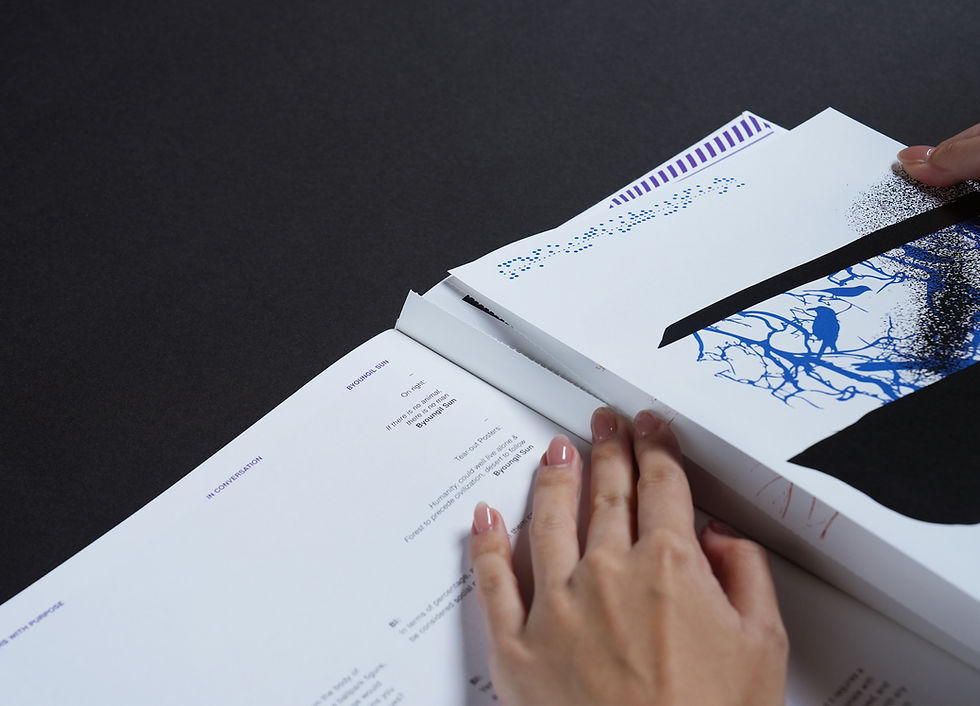
Inside, the designers are presented as distinct layers within the wider research enquiry. Selected works appear as folded, perforated posters that readers can remove, handle and examine. The tactile structure brings the material qualities of poster design to the foreground and asks the reader to engage physically as well as intellectually with the work.
The 150-page publication measures 24 × 30.5 cm. I served as Art Director and the project's lead designer, working with Singaporean Graphic Designer Cammie Toh, while Lisa Peh of Afterdusk Media created the publication photography.
Why this award matters
AIGA’s 50 Books | 50 Covers programme began in 1923 and is now in its 102nd year. The 2025 jury was chaired by Scott Vander Zee, graphic and typeface designer and educator at Pratt Institute and Parsons The New School, alongside esteemed designers and educators from across the USA. The award therefore provides independent recognition from an eminent professional and educational context, while the book’s inclusion in Columbia University Library gives the project a lasting institutional presence.
The award also provided me with an important opportunity to reflect on how the impact of a design research publication can be understood, documented and measured.
Impact is not one-dimensional. A project such as Posters with Purpose can generate scholarly, social, cultural and pedagogical impact at the same time, but each form requires different evidence.

Scholarly impact
Scholarly impact is often measured through citations, peer-reviewed publications and academic uptake. For research through design, however, those indicators alone are too narrow.
A designed research output can also demonstrate scholarly impact through:
independent peer recognition
accession into research collections
use by scholars, students and institutions
invitations to speak, exhibit or publish arising from the project
references in academic writing, teaching materials and research projects
the development of new methods, frameworks or modes of enquiry
Posters with Purpose already demonstrates nearly all of these indicators.
As mentioned above, the project was developed through a CoHASS Seed Grant, positioning it clearly within a research context. It has received international peer recognition through AIGA, the Red Dot Design Award, the Asia Design Prize Gold Award and The Communicator Awards Award of Excellence. It has also been accessioned into the Cooper Hewitt, Smithsonian Design Library and will enter the permanent AIGA Collection at Columbia University Library. I’ve been invited to speak at several academic conferences and symposiums to discuss the project, and I hope to share more about those in the coming months.
If anyone is interested in me giving a talk or running a workshop based on this project, then please do reach out!

Social impact
Social impact concerns how research influences public understanding, attitudes, debate or behaviour.
For a publication focused on ethics and visual advocacy, this impact has emerged through engagement, reflection and discussion.
Relevant evidence might include:
reader responses and testimonials
public talks, workshops and discussions
media coverage addressing the book’s ethical themes
audience engagement with exhibitions or related events
evidence that readers reconsidered their own design practices
use of the book by advocacy groups, educators or community organisations
public discussion generated through social media, reviews or events
Posters with Purpose contributes to social impact by making questions of ethics, power, visibility and responsibility accessible through design. Its focus on non-commercial poster practice asks readers to consider how visual communication can amplify voices, frame social issues and shape public attention.
The book therefore creates a platform for ethical reflection. Its social impact can be documented through the conversations it prompts, the audiences it reaches and the ways in which readers or practitioners apply its ideas to their own work. However, this is much harder to measure effectively.
I’d be really interested to know if you’ve used or would like to use this book in your workshop, classroom or workplace. Again, please reach out; I’d be really keen to work with people on this.

Cultural impact
Cultural impact concerns the contribution a project makes to creative practice, cultural memory, public discourse and the preservation or reinterpretation of knowledge.
This can be measured through:
inclusion in museum, archive or library collections
design awards and professional recognition
exhibitions and public presentations
reviews in cultural and design media
international distribution
influence on contemporary design practice
preservation for future research and public access
Posters with Purpose brings together three designers whose practices are rooted in three distinct cultural contexts: the United States, Europe and South Korea. Each interview offers a different cultural reference point for understanding poster design, visual advocacy and social responsibility, showing how local histories, values and visual traditions shape both message and method.
The chapter featuring Professor Sun is presented in both Korean and English. This dual-language treatment recognises language as part of cultural identity and preserves the specificity of his voice and practice, rather than filtering it entirely through English translation. The book therefore documents more than three individual practices. It preserves three culturally situated perspectives on the ethical and social role of posters and places them in dialogue within a wider international enquiry.
Its accession into the Cooper Hewitt, Smithsonian Design Library and forthcoming inclusion in the permanent AIGA Collection at Columbia University Library provide concrete evidence of cultural recognition and preservation, and to date the book has received six international design awards and has been exhibited in China, Poland, Germany, USA and in online galleries. Distribution through Basheer Graphic Books in Singapore and Draw Down Books internationally further extends its cross-cultural reach.
Its cultural impact lies partly in ensuring that these perspectives remain available for future study, while also positioning contemporary poster design as a serious form of public and cultural discourse.
Pedagogical impact
Pedagogical impact concerns how research contributes to learning, curriculum, teaching practice and student development.
It can be documented through:
inclusion in course reading lists
use in lectures, seminars or workshops
student responses and reflective writing
adoption by other educators
development of teaching activities based on the publication
evidence of changes in students’ ethical reasoning or design decisions
requests from schools, universities or professional bodies to use the work
Posters with Purpose was designed to function as more than a conventional academic text. Its interviews, removable posters, unfolding jacket and tactile structure make it particularly suited to active learning.
Students can examine the posters as physical artefacts, compare visual strategies, discuss ethical intentions and consider how form affects meaning. The publication encourages close looking, critical discussion and reflection on the responsibilities of visual communicators.
Its pedagogical value can be measured through classroom use, student work produced in response to it, educator feedback, curriculum integration and the development of workshops or assignments based on its themes. In this sense, the book functions simultaneously as a research output, a teaching resource and a prompt for ethical enquiry.

A growing body of recognition
The AIGA award is the latest international recognition for Posters with Purpose. The book has also received:
A Red Dot Design Award 2026
Award of Excellence at The Communicator Awards 2026
Winner in Creative Quarterly issue 82
Shortlisted for the 2026 C-IDEA Design Awards
These outcomes provide evidence that the publication is operating across several domains at once: as a scholarly output, a designed object, a teaching resource and a contribution to the cultural record.
That is the broader significance of this award.
It recognises the quality of the book, but it also helps extend the reach, visibility and continuing impact of the research it contains. All 100 winning publications can be viewed in AIGA’s online Winners’ Gallery.
Posters with Purpose: In Conversation with 3 Contemporary Poster Designers is available in Singapore from Basheer Graphic Books and internationally through
Draw Down Books https://draw-down.com/products/posters-with-purpose-in-conversation-with-3-poster-design-masters
Find out more about Lisa Winstanley and DEVIL at www.researchdevil.com


Comments